“Run.”: Raising Awareness for Greyhounds and Galgos
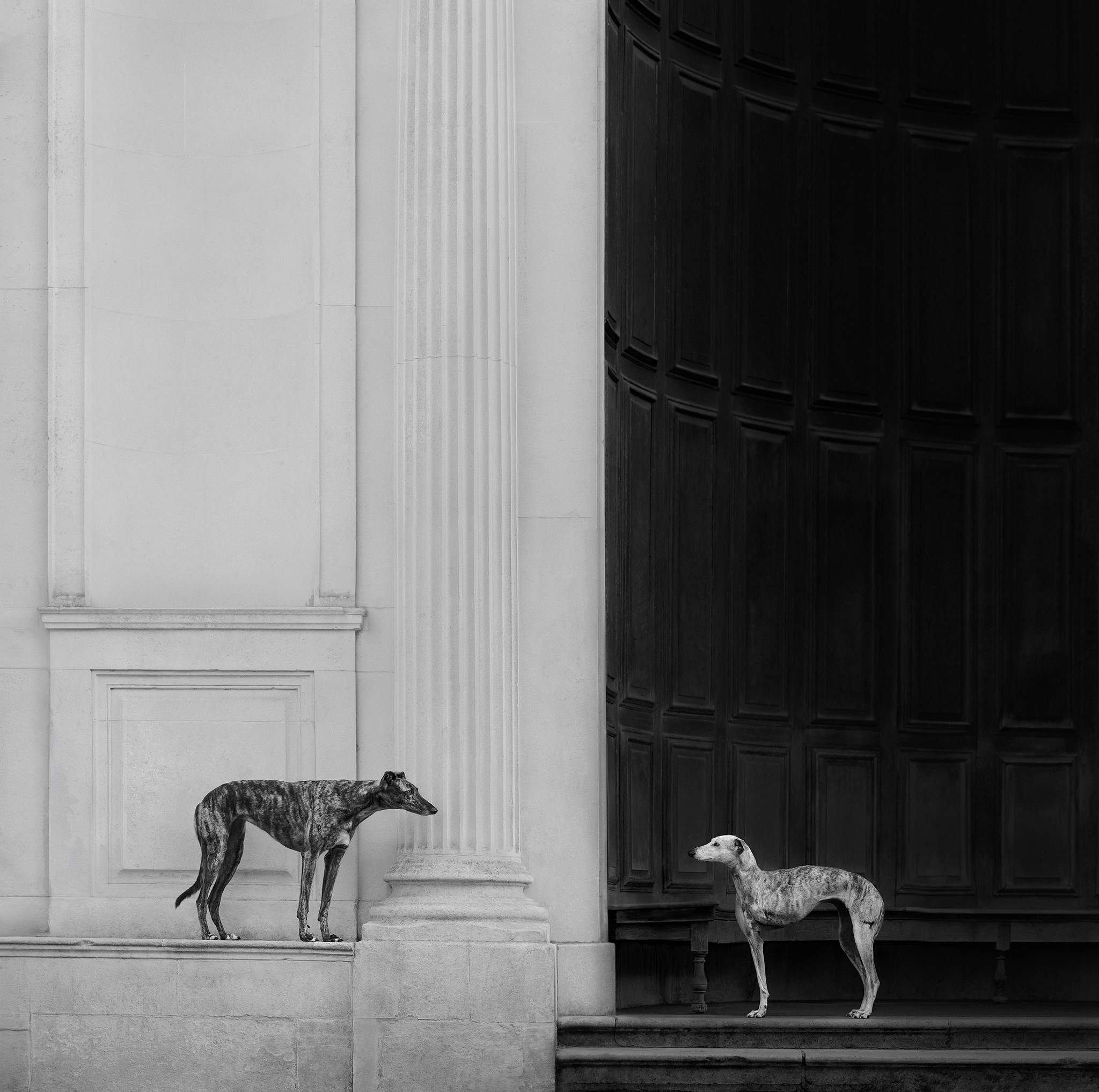
Elena Marchi won the prize in the “Open” category with this photo of two dogs looking at each other curiously. But behind this image lies a story that reveals the sad fate of greyhounds and galgos, which are used for racing and hunting.
Where does your passion for dog photography come from?
It’s probably quite funny, but my passion for dog photography actually came from a mix of adoration for my cats, a passion for wall art, and a bit of a dislike for photographing landscapes! I grew up in Italy and learnt photography from my dad, who was an amateur photographer. We would go out with his analogue Pentax and photograph landscapes around where we lived, and I’d spend hours reading his photography books. I saved up for my first camera and took my first formal photography course when I was 15, with two photojournalists who encouraged me to develop my own style which, at the time, involved experimenting with long-exposure black and white portraiture.
I later moved to London to study photography and digital imaging and found a job in a fine art printing lab. We produced work for galleries, hotels, interior designers, artists and photographers, and that’s where I really fell in love with photography as something tangible, rather than just an image on a screen. By then, though, I’d actually lost a lot of my enjoyment in taking photographs myself. I had some of my landscape work for sale through a gallery, but neither creating nor promoting it brought me much joy, so for a while I put the camera down and became much more invested in printing. Through my work, I also became fascinated by bespoke portraiture and by how much more meaning art can bring to a home when we have a personal connection to it. I started wanting beautiful portraits of my own cats for my walls and looked amongst the photographers we worked with for someone I could commission, but I couldn’t quite find what I had in mind. Eventually, I thought I’d try to create it myself.
And that’s really how my cats brought me back to photography. Photographing my girls brought the joy back almost immediately. I started experimenting with my parents’ dogs too, initially just for fun, and began thinking about our dogs, who are such an integral part of our lives, and how wonderful it would be for them to become part of the art we live with too. The more I photographed them, the more I realised how perfectly the form and energy of a dog could fit the kind of artwork I had been imagining. And that’s probably what still fascinates me most. You can photograph two dogs in exactly the same place and come away with completely different images because of the way each one moves, observes and interacts with the environment. I love meeting them and figuring out how to photograph that particular dog, rather than imposing an idea onto them. Then there are the humans behind them too: the laughs during a session and that look when someone sees the finished portrait of their dog for the first time. Somewhere along the way, I realised I’d found a subject I actually wanted to photograph and learn from every day.
Your photographs are often created in black and white, could you tell us why?
I actually get asked by clients quite often whether I shoot in colour. And the short answer is that I don’t. It isn’t really because I made a deliberate choice at some point, but because I probably just see things differently. The longer answer is that I find colour quite fleeting. It can tie an image to a particular time, mood or version of reality, while I’ve always been more interested in what remains underneath when colour is removed: the shapes, the light, the lines and the character of the subject.
I like to think about ancient Greek temples. They were originally painted in vivid reds, blues and golds, which is so different from how we see them today. Those colours have disappeared over time, leaving the raw beauty of the stone exposed. What we notice and appreciate today are the shapes, the craftsmanship and the history behind them. Black and white portraiture works in a similar way for me.
What interests me about a dog isn’t the exact colour of their fur or eyes, or the seasonal colours that tint the location, but the way they hold themselves, their expressions, the shapes they create and the way light falls across them. For me, colour tends to describe what something looks like, while black and white gives me the freedom to interpret what I think is important about it. It isn’t necessarily meant to reproduce reality. It can simplify it, emphasise it and let the photographer decide what deserves our attention.
Throughout the process, what posed the greatest challenge for you?
Most of my images are created using a handheld panoramic stitching technique, and Run. is actually made from over 30 individual photographs stitched together. It means I essentially have to become my own tripod: once I start shooting, I need to remain in exactly the same position while rotating and capturing all the individual frames that will eventually make up the final image. And this is mostly because shooting on a tripod is forbidden in several areas around London.
That makes most of my photographs slightly nerve-racking, because I never really know until I’m back at my computer and start stitching everything together whether I’ve captured all the pieces correctly, or whether the image I had in my head is actually going to be possible.
Run. came with an extra challenge because the two dogs were photographed separately. I wanted them to appear as though they were looking at one another, but I also wanted to introduce them to the space and photograph them individually, so they could concentrate without being overwhelmed or distracted by each other.
Once I had started the panorama, though, I couldn’t move. So while the owners were positioning the dogs, I couldn’t walk over to help or physically show them what I needed. I had to stay behind the camera, explain everything from where I was standing and hope we could make it work. And they were absolutely incredible, all of them!
We also had to work out exactly where each dog needed to look so that, once the photographs were brought together, their eyelines would meet naturally, even though the other dog wasn’t actually standing there. And I didn’t just want them to turn their heads in the right direction. I wanted them to look genuinely engaged and curious.
So there was quite a lot that had to come together, and only one real chance to capture it, as we were on a deadline, and one of the owners had come from quite far. And after all of that, I still couldn’t know for certain whether it had worked until I got home and stitched those 30+ photographs together.
What feeling did you want to convey while creating this image?
Run. was created as the cover of my fundraising book, Greyhounds & Galgos: Echoes of London, released earlier this year, which aims to raise awareness of these two breeds and the difficult realities that many of them face.
I knew from the beginning that I wanted the cover to bring a greyhound and a galgo (Spanish greyhound) together. They are two similar breeds, historically used for different forms of hunting and racing, and both have suffered as a consequence of the purposes we have assigned to them. But I also wanted to acknowledge that their circumstances aren’t identical. In Spain, hunting dogs, including galgos used for hunting, were excluded from the country’s national animal welfare law, and their treatment remains a major concern for rescue and animal welfare organisations.
On the left is Tora, a greyhound, standing against the light. On the right is Ronda, a three-legged galga whose body shows evidence of a somewhat harsher story, standing in the darkness. I wanted the architecture to create an almost literal division between what we are comfortable seeing and what can remain out of sight.
Despite the physical division, however, I wanted the two girls to acknowledge one another. They are looking across that line and having, in my mind, a kind of silent conversation, which is where the title came from.
When I look at the photograph, I imagine Ronda whispering to Tora: “Run.” as a warning of what might happen if she doesn’t run fast enough to meet the expectations placed upon her. And I wanted Tora to lean forward with curiosity, almost as if she were asking Ronda what had happened to her. Only her owners will know this, but what is also special to us about this shot is that Tora also broke a leg while racing, which is why she was given up.
Lastly, can you give us a glimpse into any upcoming projects you’re currently working on?
Lately, I’ve actually been focusing on enjoying my photography commissions and spending quite a lot of my time with my foster galgo, so I’ve allowed myself to slow down a little when it comes to personal projects.
But we’ve recently started discussing and organising a photography tour in Hong Kong, which would be an absolute dream for me. Architecture plays such a huge part in my work, with dogs in it, of course! And Hong Kong has such an incredible mix of architecture, density, scale and geometry that I can already imagine endless possibilities for photographs there. It’s still in the early stages, but the idea of taking the way I photograph here in London and seeing how it translates into a completely different city is incredibly exciting.
More about Elena: www.pawtiqe.com