Beyond the Track: A Galgo in London
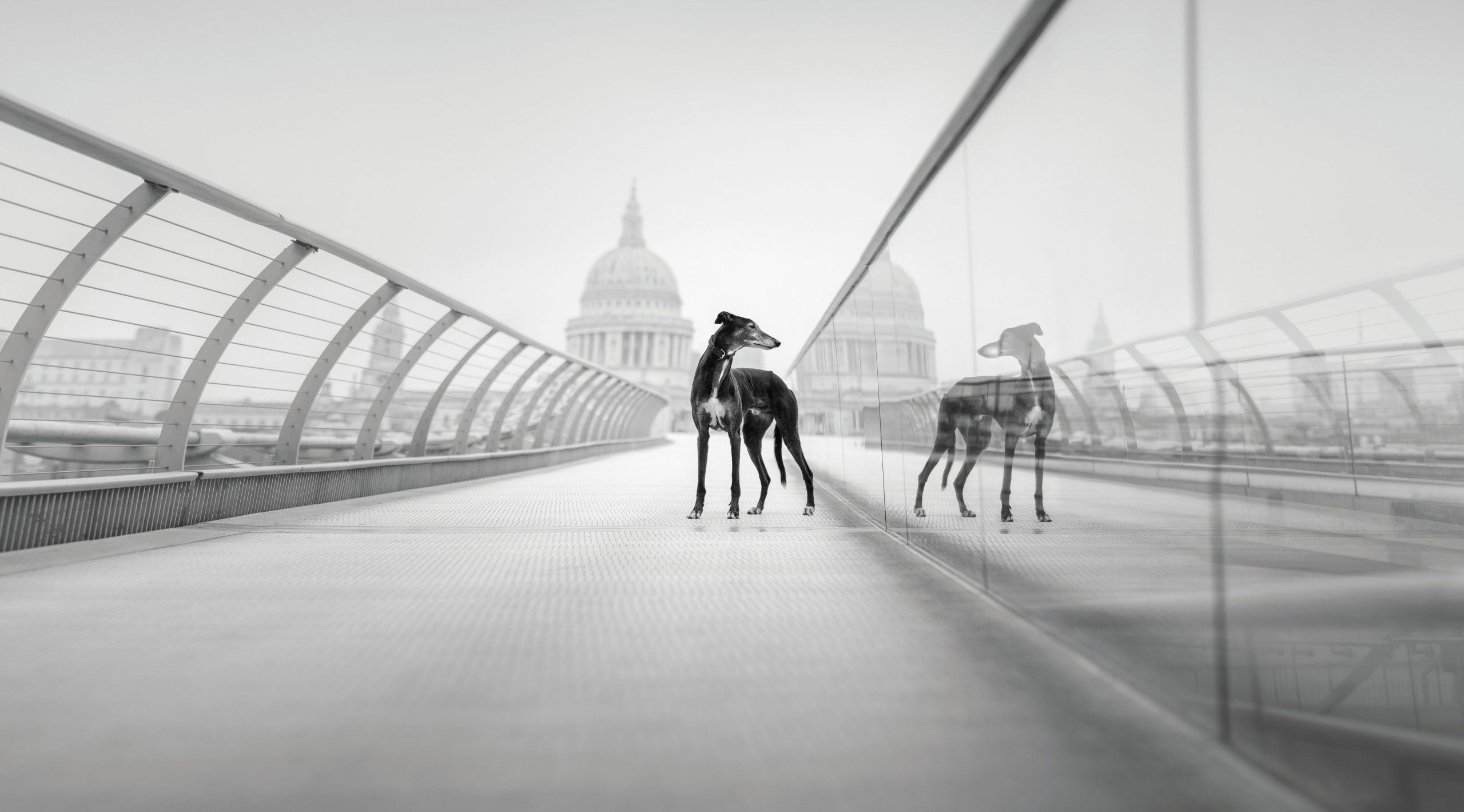
This portrait of a Galgo in London won first place in the most popular category of our contest: “Outdoor Portrait.” Elena Marchi shares her love for Galgos, as well as the challenges of working with dogs in the city. The image “Beyond the Track” was created as part of her book *Greyhounds & Galgos: Echoes of London*, in which all dogs from shelters were eligible to participate.
Why did you choose to capture this image in a panoramic way?
The panoramic format is a big part of the way I photograph because I don’t really see the location as a backdrop. The architecture is as much a part of the composition as the dog is, and I wanted Beyond the Track to show the scale and architecure of the bridge and the vastness of the city around the dog. At the same time, I didn’t want him to get lost within all that space. The lines of the bridge naturally lead your eye towards the centre of the image, where he stands, and then down to her reflection, which was a very important part of the composition. That’s what I love about working panoramically. I can give the architecture enough room to feel impressive and expansive, while still using it to guide you back to this relatively small dog standing at the centre of it all. For me, the contrast in scale makes you notice him even more.
You often photograph hounds, are these breeds close to your heart?
Very much so. I actually tried to adopt a greyhound years ago and was rejected several times. That experience was part of what made me want to use my photography to showcase rescue dogs and support charities that look at dogs and potential adopters as individuals, rather than automatically excluding someone because they live in a flat or work full time. I’d always been drawn to greyhounds and sighthounds more generally, both for their personalities and for how incredibly beautiful they are. My family also has three different sighthound breeds, so they’ve gradually become a very big part of my life. But I think my connection with them really deepened when I started working with sighthound-specific rescue charities. I met more of these dogs, listened to their stories and learnt more about what happens to many greyhounds and galgos, salukis and podencos before they reach rescue. The more I learnt, the more I also realised how many misconceptions surround them, both about where they come from and what they are like to live with. And purely from a photographic point of view, I find them endlessly interesting. There’s something about their elegance and goofiness, their shapes and that soulful quality they have that works incredibly well against the lines of architecture and the grandeur of London. They can look almost sculptural within the city, which makes them particularly fascinating for the kind of work I create.
How difficult is it to photograph dogs in the city? How do you keep the dogs safe?
Photographing dogs in a city definitely comes with its challenges, but a lot of the work happens before the dog arrives. I scout every location beforehand and choose the best time of day for that particular spot. We usually photograph on weekends at sunrise, when London is at its quietest, both to give us more freedom to work and to make the experience calmer and safer for the dog. The vast majority of dogs are photographed on lead, which in many locations is a legal requirement anyway, but more importantly is a safer for evryone. The lead and owner can simply be removed from the final photograph afterwards. I actually find this often creates much more natural portraits, too. Rather than asking a dog to hold a stay, remain somewhere alone or think too much about what we’re asking them to do, they can simply stand beside their person on lead and behave as they normally would. At that point I can concentrate on observing them and simply wait for the expression or movement I want. Like most dog photographers, before every shoot I have a thorough conversation with their owner so I can understand the individual dog I’m going to photograph. One might be reactive to other dogs, another might struggle with bicycles or crowds. Some are anxious, some have a very high prey drive, and some will just want to launch themselves into any body of water they see! So the location, day, time and way we work are all planned around that particular dog. I also scout with several options in mind so that we’re not standing around waiting for me to find inspiration. And if something isn’t right on the day, we move on. Getting the photograph is never more important than keeping the dog comfortable and safe.
Is this image taken during a client photoshoot, or is it from a personal project?
A bit of both, actually. Beyond the Track was photographed specifically for my book, Greyhounds & Galgos: Echoes of London, so it was part of a personal project, but the individual sessions worked very much like my usual commissions. I didn’t select or cast the dogs for the book. Anyone with a rescue greyhound or galgo could book a session to take part, so I never really knew who I was going to photograph until they came along. I would suggest locations that I thought could work, and then we’d create something around whichever hound turned up. I really loved working that way because it kept the project true to how I normally photograph. I wasn’t looking for dogs with a particular appearance to fit images I had designed. The location might give me the starting point, but the dog ultimately made the final photograph. Some hounds would have just one portrait taken, others would allow me to experiment with several angles. Ben here, alongside his brother Charlie, gave us three different shots on the bridge, all of which ended up in the book.
Lastly, what does winning this award mean to you?
It honestly means a lot more than I expected it to. I submitted the images hoping they might do well, of course, but I never really thought I would win. I’ve entered awards before and reached the finals several times without ever quite making it further, and after a while I became quite discouraged. I started wondering whether the kind of work I create simply wasn’t the kind of work that would do particularly well in competitions, so I actually took a break from entering them altogether. Winning two categories at the Dog Photography Awards with work that feels so representative of what I love creating is incredibly encouraging. I also recognise and know some of the photographers whose work was awarded and nominated this year, including some I’ve found myself alongside in previous finals, and they are photographers whose work I truly admire. Not to mention the judges! The standard of dog photography from around the world is extraordinary, so to have my photographs recognised alongside their work means a lot. But I think what makes it particularly special is which photographs were recognised. All three of my awarded images portray either a greyhound or a galgo, and they’re part of a body of work that has become incredibly personal to me. I’m attached to some of the dogs themselves, but also to their humans, some of whom devote so much of their own lives to helping sighthounds in need. Knowing that their dogs’ portraits are now being seen and celebrated internationally makes me incredibly happy. Since fostering galgos myself, I’ve also realised just how little awareness there still is around the breed. People stop us almost every day to ask what breed they are, and most have never heard of galgos before. But they’re usually curious, and suddenly we’re having a little conversation about the breed and what many of these dogs go through. I think photography can do something similar. These portraits might be recognised first as photographs, but if that recognition allows them to travel a little further, makes somebody stop and look at these dogs for a little longer, or perhaps discover a breed they knew nothing about before, then that makes the award even more meaningful to me.
More about Elena: www.pawtiqe.com