“Loved and Hated”, a Tribute to Bully Breeds
In her award-winning photo, Katie didn’t just capture a beautiful image of a dog; she also shed light on the injustice faced by so-called “dangerous” dog breeds. In this interview, Katie shares with us the hardships endured by Caldwell, the dog she adopted and has photographed from every angle since bringing him home.
Can you walk us through your creative process for your winning image « Loved and Hated »?
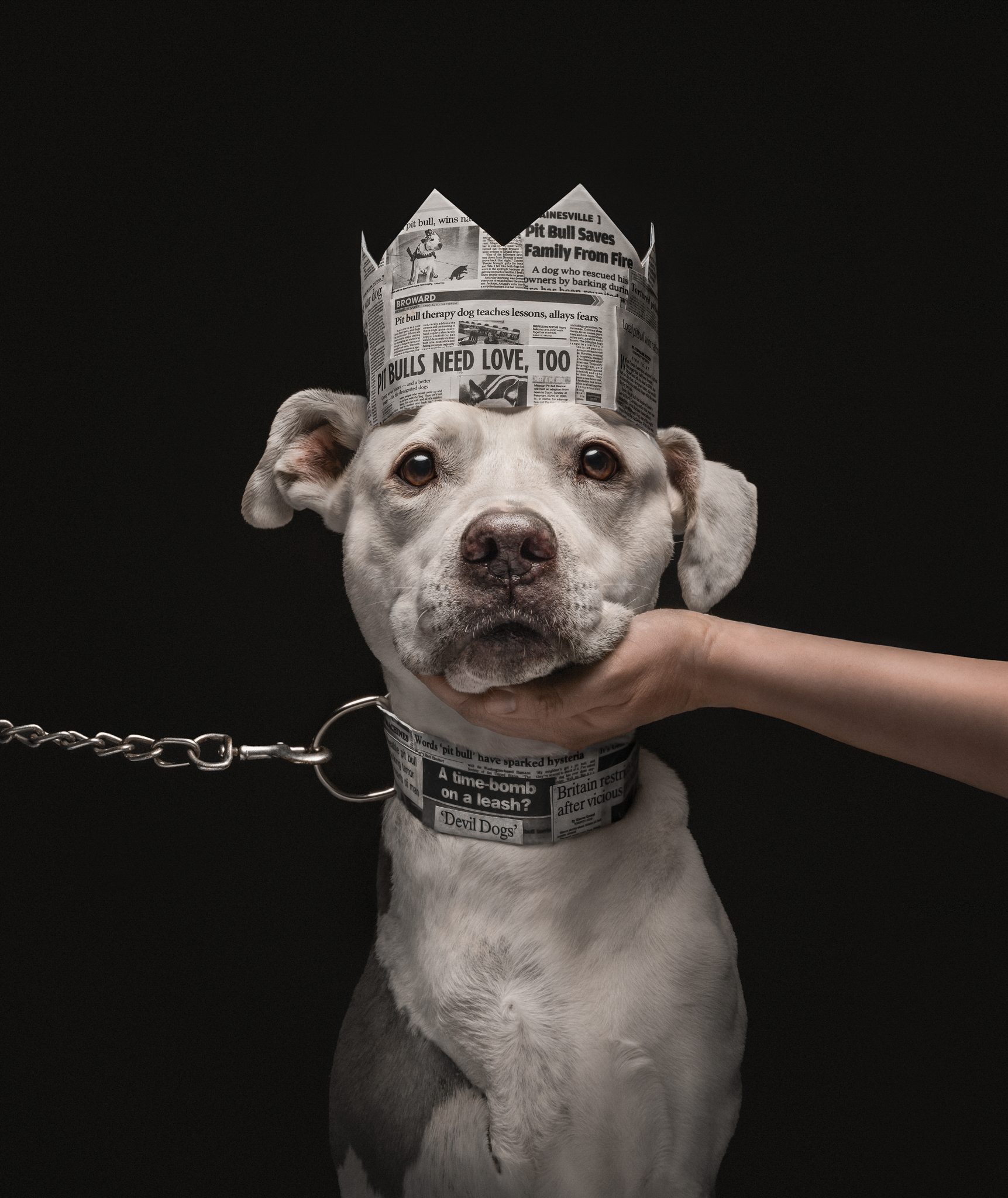
For this image, I wanted to convey society’s complicated relationship with pitbulls and bully breeds. The collar and chain represent breed bans, restrictions, and other ways pitbulls are punished simply for existing, while the crown and gentle hand represent the advocates who support and love the breed. Meanwhile, the dogs themselves are caught in the middle between the two sides.
I created the collar and crown myself out of construction paper, and all the newspaper clippings are real headlines from various papers.
Your image conveys a powerful message. Do you feel the perception of bully breeds is changing for the better?
I think it is, though progress is slow and there are still some setbacks. It’s disappointing that so many countries and cities still have breed bans, and there’s no shortage of pitbull critics online.
But I’m encouraged to see that, at least in the U.S., public perception is beginning to change as pitbulls become more popular pets. Photographers like Sophie Gamand have done wonders in advocating for these dogs, and I think the rise of popular dog accounts on social media has also helped many people see bully breeds in a different light.
It’s still a long road until pitbulls are treated equally to other breeds, but with so many people advocating for them, I’m confident we’ll get there eventually.
Do you know about Caldwell’s past? How long has he been part of your family?
I wish I had known Caldwell as a puppy (can you imagine how adorable he must have been at 8 weeks old??), but I have known him since he was 2 years old. He was found as a stray in 2015 and brought to the local animal control, where he was never claimed. As an adolescent, high-energy bully breed, the cards were already stacked against him, and he was eventually put on the euthanasia list when he ran out of time.
Fortunately, he was transferred to a different shelter at the last minute, and I happened to be a volunteer dog walker there. I met him shortly after he was transferred and immediately fell in love with him, and I made sure to take him out every weekend during my volunteer shifts.
He was still overlooked by adopters, though, and after around 3 years in the shelter, he was developing some significant behavior challenges due to the stress of spending 23 hours a day in a kennel — which were making it even less likely he’d ever be adopted.
I was living in an apartment at the time, and where I live, it’s nearly impossible to find rentals that allow bully breeds. So I made a totally normal and rational move, and I bought a house specifically so I could adopt him. I officially brought him home for good in October 2018, and the rest is history.
Throughout the process, what posed the greatest challenge for you?
Honestly, the actual capture itself was the toughest part, because I really needed a few extra hands. Since I was taking this photo alone, I had to figure out a way to hold the leash, hold my hand under Caldwell’s chin, and hold a treat in front of the camera so he’d look straight ahead instead of at me. Oh, and actually take the picture, too.
I ended up putting my camera on a tripod and setting it to interval shooting so that it would fire off a bunch of shots hands-free. Then I wrapped the handle of the leash around a spare light stand so that I could sit next to Caldwell and hold his chin in one hand and a treat in the other. Thankfully, Caldwell is a true professional and happily went along with everything I asked of him!
From your experience, what’s the most important mindset or approach that helped you achieve this recognition?
I’ve found that creating images for myself has actually helped with awards and competition. When I first started entering competitions, I worked so hard to finesse my images in a way I thought the judges would like — even if it wasn’t my style. Even if those images did gain recognition, it didn’t mean as much because those photos didn’t feel like me.
Now, I only enter images that I have some type of personal connection with. That’s often a personal story (like with this image, as I’ve experienced firsthand the hate that bully breeds receive), or it could be an image that pushed me out of my comfort zone and forced me to grow.
I don’t really know whether any of that has actually made a difference in my competition results, but it definitely does make this recognition feel so much more special when it’s for an image that’s very close to my heart!
More about Katie Brockman: Katie Brockman Photography